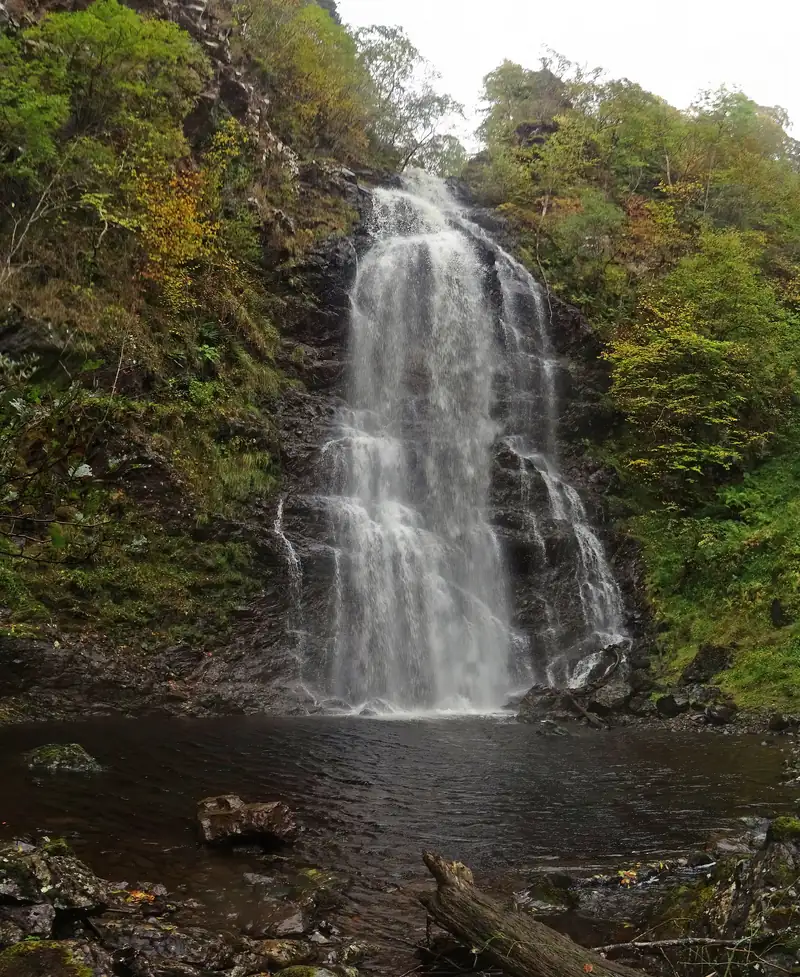
The Falls of Foyers are a two-step waterfall on the River Foyers, on the quiet south-east shore of Loch Ness, dropping 144 ft (44 m) in all. A steep path with steps leads from the road to two viewing platforms. They are free, 31 minutes from Inverness and about 45 minutes by road from Drumnadrochit.
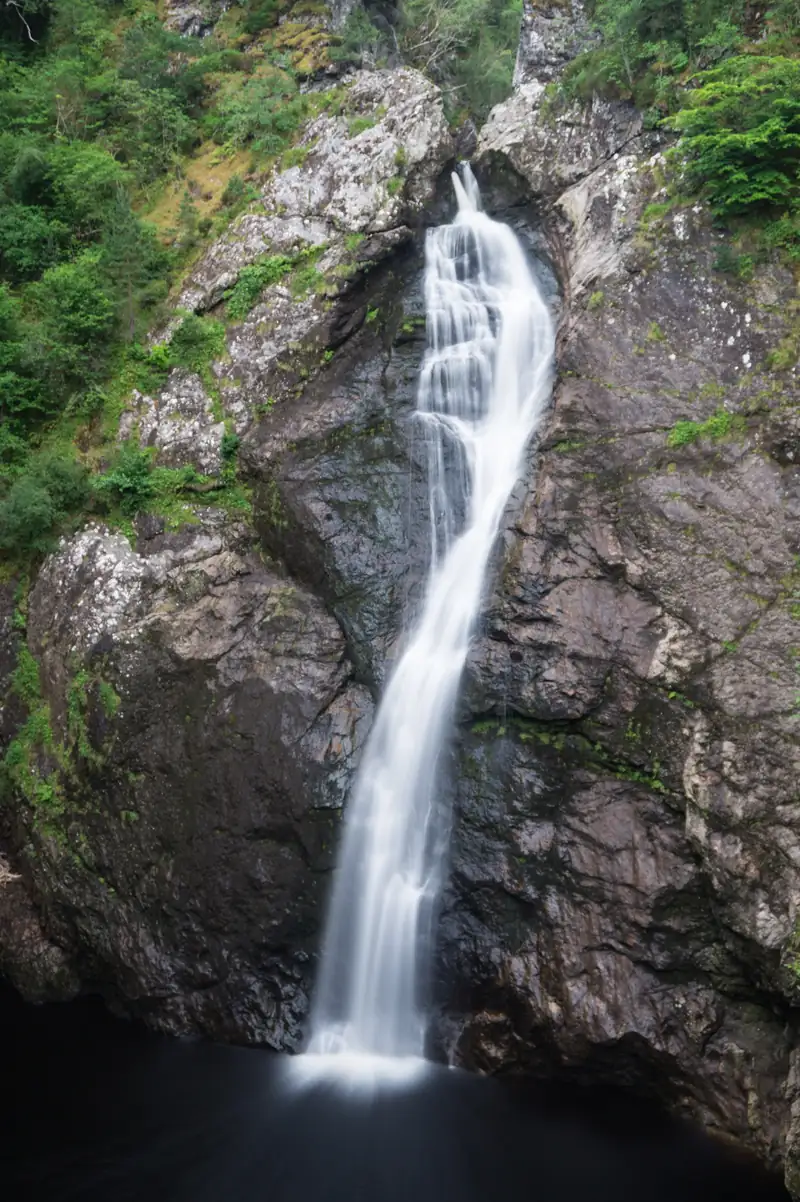
The Falls of Foyers are a waterfall on the River Foyers, on the south-east shore of Loch Ness, about halfway along the loch. The river drops 144 ft (44 m) in two falls into a deep wooded gorge: an upper fall of 46 ft and a lower one of 98 ft. Some guides give 165 ft; the 44 m figure is the better-supported one. Entry is free, a steep stepped path leads to two viewing platforms, and the drive from Drumnadrochit takes about 45 minutes because you have to go round the end of the loch.
|
Detail |
| Height |
144 ft (44 m): upper fall 46 ft (14 m), lower fall 98 ft (30 m) |
| Drive from Drumnadrochit |
32.1 miles, about 45 minutes via Fort Augustus |
| Drive from Inverness |
19.6 miles, about 31 minutes via Dores |
| Drive from Fort Augustus |
13.4 miles, about 19 minutes |
| Parking |
Falls of Foyers car park (Highland Council): Invitation to Pay donation, 24-hour maximum |
| Bus |
Highland Council 302, Inverness to Foyers via Dores |
| Entry |
Free, open access |
Checked October 2026. Drive times by OSRM routing, free-flow.
What you see
The path starts by the road above the falls and drops quickly through woodland. Visit Inverness Loch Ness warns of “a lot of steps to get to the two viewing platforms”, and Fiona Outdoors, writing in April 2026, describes the path as narrow and steep but well made, “with steps where needed”. From the platforms you look across the gorge at the lower fall, a single white column down dark rock into a pool. Red squirrels live in the pines around the path.
The Gaelic name, Eas na Smùide, means “the smoking falls”, after the spray. You get the full effect only when the river is high. Since the 1890s much of the water above the falls has been taken for hydro power, first by the British Aluminium Company’s smelter and later by the Foyers pumped-storage scheme, so in a dry spell the falls can be thin. Fiona Outdoors found them in spate after rain in April 2026. Plan your visit for a day after wet weather if you can.
A longer walk
A longer path continues below the falls down to the loch side. For a proper outing, Fiona Outdoors describes a 12 km circuit from the free Forestry and Land Scotland car park at Inverfarigaig that takes in the falls, with about 500 m of climbing in total. The South Loch Ness Trail also passes through Foyers on its way between Fort Augustus and Inverness.
Burns, hydro and history
Robert Burns visited in 1787 and wrote “Lines on the Fall of Fyers, near Loch Ness”. The Wordsworths and Robert Southey came too, and MacBrayne steamers on the canal route later carried tourists to see the falls. In 1834 a visiting lecturer, Robert Addams, described the “waterfall illusion” after watching them: stare at falling water, then look at the rocks, and the rocks seem to drift upwards.
Industry changed the falls. The British Aluminium Company began building a hydro-powered aluminium smelter here in 1895, the first in the UK, and celebrated its first production in June 1896. Its intake just above the falls cut their flow, despite public objections. The smelter closed in 1967. The village grew around it: Upper Foyers was a crofting township, and Lower Foyers was built for the works’ staff, with the falls between them.
Getting to the Falls of Foyers
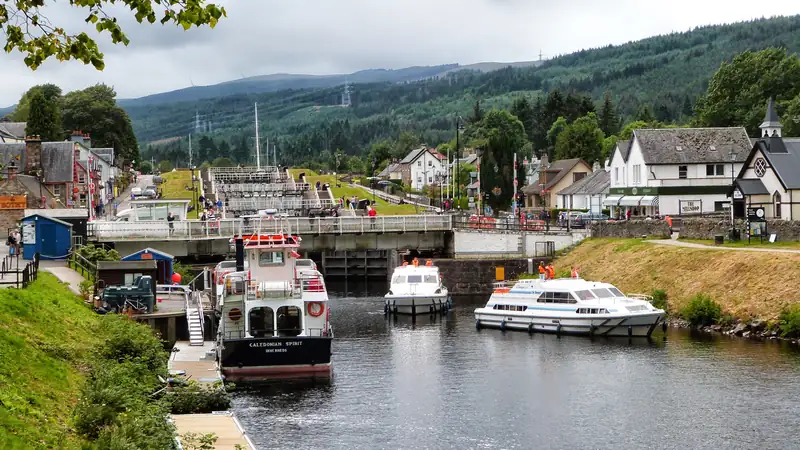
From Drumnadrochit: no bridge or ferry crosses Loch Ness, so drive south on the A82 to Fort Augustus, then take the B862 and B852 up the east side, about 45 minutes in all. Going round by Inverness and Dores takes nearer an hour.
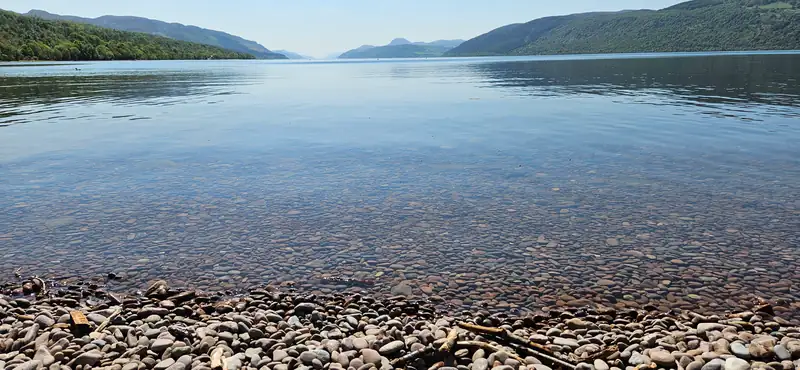
From Inverness: about 31 minutes via Dores along the east shore. Dores Beach makes a good stop on the way.
By bus: Highland Council’s service 302 runs from Inverness bus station to Foyers via Dores and Inverfarigaig, with stops at Upper Foyers shop and the Foyers Hotel. It does not serve the west shore, so it is no help from Drumnadrochit. Check times on Traveline Scotland before you rely on it.
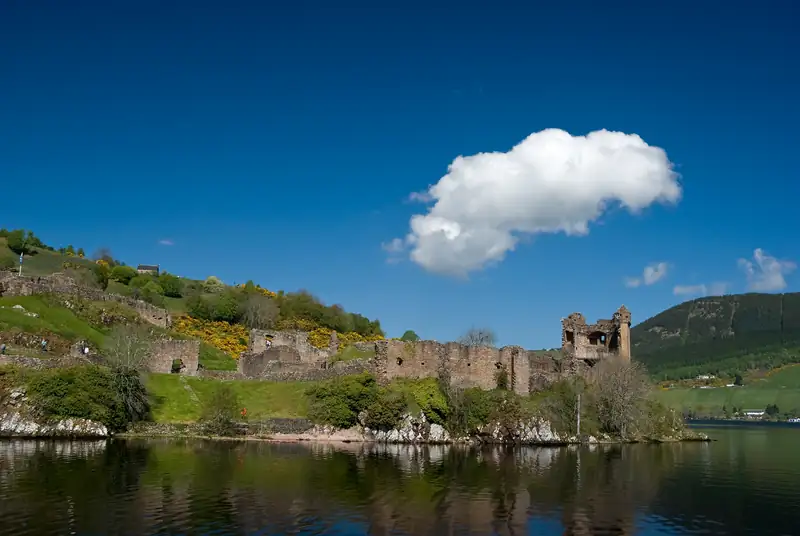
On a tour: the small-group lap of the loch from Inverness stops at the falls between Dores and Fort Augustus, and finishes at Urquhart Castle with a cruise. The cheaper coach loop also stops here.
Parking and facilities
The car park at the falls belongs to Highland Council. Its 2026 draft parking order lists it as an “Invitation to Pay” site, which means a donation rather than a charge, with a 24-hour maximum stay. A shop by the start of the path sells snacks and ice cream. Visit Inverness Loch Ness names Cameron’s Tearooms in Foyers, which keeps Highland cows, and The Craigdarroch for lunch and dinner; check opening times out of season.
The free Forestry and Land Scotland car park to the north at Inverfarigaig has free public toilets and suits the longer circuit.
Falls of Foyers or Divach Falls?
If you are staying in Drumnadrochit, Divach Falls is the waterfall on your own side, a 100 ft drop in oak woods above the village, though its access road has been closed since a landslip in December 2024. Foyers is the bigger outing and pairs well with Dores and Fort Augustus in a loop of the loch. For more of the east shore and where to sleep, see things to do at Loch Ness and where to stay at Loch Ness.