Culloden Battlefield is 5 miles east of Inverness, where the government army defeated the Jacobites on 16 April 1746. The National Trust for Scotland runs the visitor centre: £12.50 for adults, open daily 9am to 5pm until 1 November 2026, then 9am to 4pm. The battlefield itself is open every day of the year.
Culloden Battlefield is the moor 5 miles east of Inverness where the last Jacobite rising ended on 16 April 1746. In less than an hour the Duke of Cumberland’s government army broke the army of Prince Charles Edward Stuart. The National Trust for Scotland (NTS) now cares for the site. You can walk the battlefield free at any time; the visitor centre and museum charge £12.50 for an adult.
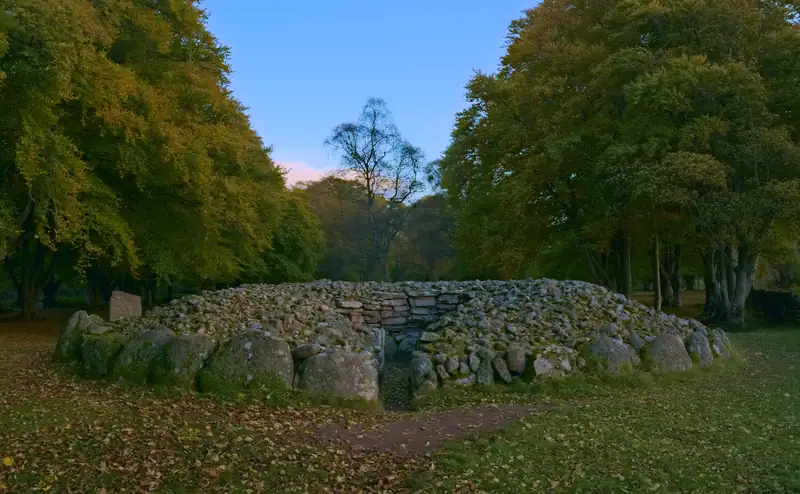
From Drumnadrochit on Loch Ness it is about 22 miles, a 35 to 40 minute drive through Inverness. Most people pair it with the Clava Cairns, three minutes down the road.
Tickets and opening hours
Checked October 2026 on the NTS planning page.
| Ticket |
Visitor centre |
Visitor centre and guided battlefield tour |
| Adult |
£12.50 |
£16.50 |
| Concession |
£11.00 |
£15.00 |
| Child |
£8.00 |
£12.00 |
| Family |
£33.00 |
£43.00 |
| One adult family |
£26.00 |
£36.00 |
| Young Scot |
£1.00 |
|
| Car park |
£5.00 (free for NTS members) |
|
| Part of the site |
Hours |
| Visitor centre and shop |
2 March to 1 November: daily 9am to 5pm, last entry 4.30pm |
| Visitor centre and shop |
2 November to 28 February 2027: daily 9am to 4pm, last entry 3.30pm |
| Café |
Until 31 October 9am to 4pm; from 1 November 9am to 3.30pm |
| Battlefield |
Every day of the year |
The Trust also sells each visitor centre ticket with a 10 percent donation added so it can claim Gift Aid (£13.75 for an adult). NTS members get in free. Guided battlefield tours are booked through the Trust’s events page.
What happened on 16 April 1746
By spring 1746 the Jacobite rising was failing. The army had turned back at Derby rather than march on London, and although it won at Falkirk in January, it was now short of food and money. NTS says the soldiers were down to three biscuits a day.
The Jacobites wanted to put the exiled James Stuart (James VIII to his supporters) back on the British throne, with his son Charles leading the army. Cumberland, the son of George II, marched his government troops from Aberdeen and camped at Nairn on 15 April, his 25th birthday. That night the Jacobites tried a surprise attack on the camp. The column moved too slowly in the dark and turned back before dawn, exhausted.
Some Jacobite commanders wanted to pull back to higher ground south of the River Nairn. Charles chose to fight on the open moor. At about 1pm the Jacobite guns opened fire and the government cannon answered. When the Highland charge finally went forward, through rain, smoke and grapeshot, the government lines held. NTS puts the whole battle at under an hour, with around 1,600 men killed, about 1,500 of them Jacobites. The Trust calls it the last pitched battle on British soil.
The defeat ended the rising. The government built Fort George, north-east of Inverness, afterwards as a base for its army, which Historic Environment Scotland says took 22 years to complete (see things to do in Inverness).
What to see on the battlefield
The moor is laid out so you can read the battle on the ground. Red flags mark the government front line, where most of the hand-to-hand fighting happened. Blue flags mark the Jacobite front line.
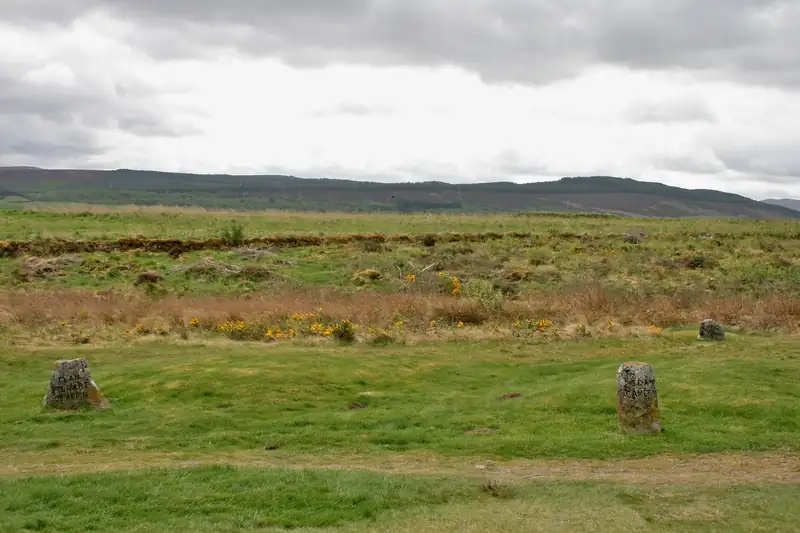
In the middle stands the memorial cairn, with the clan grave stones around it. Duncan Forbes, who owned the moor, built both in 1881. The stones mark mass graves, and NTS points out that they leave out two nations that fought for the Jacobites: Irish and French regiments are remembered by markers placed in 1994 by the White Cockade Society, on the far side of the cairns.
Leanach Cottage is the small thatched building on the field. A cottage on this spot was used as a field hospital for government soldiers after the battle; the present one was rebuilt in the early 19th century, and its thatch is heather cut from the battlefield. It now holds temporary exhibitions.
Look out for the Field of the English too. It was long thought to hold the government dead, but NTS says recent archaeology found no graves there.
The visitor centre
The current visitor centre opened in 2007. Its museum tells the story from both the Jacobite and government sides, with weapons, archaeological finds such as musket balls and a pewter cross, and a 360-degree battle immersion theatre. The roof garden looks out over the whole moor, where goats and cattle graze to keep the land close to its 18th-century state.
Dogs are allowed in the shop and café and on the battlefield (keep them close; there is livestock) but not in the museum. There is no luggage storage, so leave cases in the car. Wheelchairs are free to borrow.
Getting there and parking
The address is Culloden, Inverness IV2 5EU. Follow the brown signs off the A9 or the B9006.
- By car from Drumnadrochit: take the A82 to Inverness, then the A9 and B9006 east. About 22 miles, 35 to 40 minutes.
- By car from Inverness: about 6 miles, 15 minutes.
- Parking: the Trust’s own car park, open 8am to 6pm, £5 pay and display, free for members, with disabled bays, coach and motorhome spaces and one 22kW electric car charger. NTS warns it can fill at peak times.
- By bus: Stagecoach route 1B runs from Inverness to the Culloden Battlefield stop; check times with Stagecoach or Traveline Scotland. From Drumnadrochit, take the Citylink 919 or Stagecoach 17 into Inverness first (see Inverness to Drumnadrochit).
- On a tour: the Loch Ness, Castle and Outlander day from Inverness combines Culloden with Urquhart Castle and the Clava Cairns, which saves a lot of driving if you have no car. Another Inverness tour pairs Culloden and Clava with Glen Affric.
Tips for your visit
- Do the museum first. The battlefield makes much more sense once you have seen the immersion theatre and the maps.
- Walk out to the flags. Standing on the Jacobite line and looking across at the red flags explains the battle better than any panel.
- Bring a waterproof. The moor is open to the weather, and the far side of the field is a fair walk from the visitor centre.
If you are staying on Loch Ness rather than in the city, Drumnadrochit is a quieter base: Culloden, Clava and Urquhart Castle all fit into one long day by car.